Silhouette of Jesus Teaching Children: A Practical Guide to Using Elegant Clip Art
When designing materials for religious education, church events, or faith-based merchandise, the choice of imagery sets the tone for the entire project. The Silhouette of Jesus Teaching Children has emerged as a distinct and versatile option for designers seeking a balance between spiritual reverence and modern aesthetic appeal. Unlike traditional stained-glass illustrations or detailed oil-painting reproductions, this specific clip art style relies on bold forms and clean lines to convey a narrative without visual clutter. For adults managing creative workflows, whether for Sunday school curriculums, wedding invitations, or small business branding, understanding the utility and limitations of this format is essential for making an informed design decision.
Defining the Distinctive Appeal of Silhouette Art
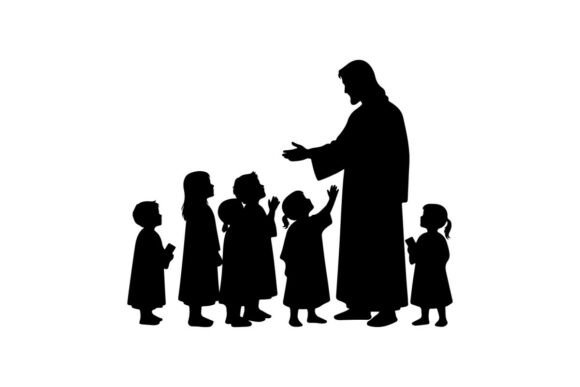
The primary characteristic that defines the Silhouette of Jesus Teaching Children is its reduction of complex scenes into simplified, high-contrast shapes. In this specific depiction, the focus is not on facial expressions or intricate clothing textures but on the posture and interaction between the figures. The silhouette captures the essence of the moment—Jesus kneeling or sitting among children, gesturing in a teaching manner—using a single color field, typically black against a transparent or white background.
This approach offers a unique advantage in modern design: clarity. When an image is stripped of detail, it becomes more legible at smaller sizes, such as on a social media icon or a sticker. The "elegant" descriptor often associated with this clip art refers to the smoothness of the curves and the precision of the edges. Because the design avoids fine lines that can blur during printing or cutting, it maintains a crisp appearance regardless of the medium. This makes the Silhouette of Jesus Teaching Children particularly effective for projects requiring a sleek, contemporary look rather than a historical or ornate one.
Comparing Silhouettes to Other Religious Illustration Styles
To determine if this asset fits your specific needs, it is helpful to compare it against other common categories of religious imagery available to creators.
Traditional Realistic vs. Stylized Minimalism
Traditional religious art often features photorealistic details, shading, and vibrant colors intended to evoke a sense of history or divinity through realism. While powerful, these images can be difficult to integrate into modern layouts that prioritize whitespace and minimalism. They may also suffer from quality loss when resized or printed on certain materials like vinyl or fabric. In contrast, the Silhouette of Jesus Teaching Children offers a stylized alternative. It sacrifices realistic detail for versatility. If your goal is to create a logo, a t-shirt design, or a cut file for a craft machine, the silhouette is often superior because it translates better across different substrates.
Line Art and Vector Outlines
Another common alternative is line art, which uses outlines to define the subject. Line art allows for coloring within the boundaries, offering flexibility for activities like coloring pages. However, line art can appear fragile or thin when scaled up for large banners or signage. The solid fill of a silhouette provides immediate visual weight and impact. Where line art might get lost in a busy background, the Silhouette of Jesus Teaching Children stands out due to its bold, unified shape. The tradeoff is that silhouettes cannot be easily recolored internally; the entire shape usually remains a single hue unless masked or layered with other elements.
Evaluating Strengths and Tradeoffs in Design Workflows
Every design resource comes with inherent strengths and limitations. Understanding these factors helps prevent workflow bottlenecks and ensures the final product meets professional standards.
Scalability and Resolution Independence
One of the most significant advantages of using vector-based silhouette clip art is scalability. Files provided in SVG (Scalable Vector Graphics) format allow the image to be resized infinitely without pixelation. This is a critical factor for projects that require both small applications, like business cards, and large formats, like vinyl decals for vehicles or window displays. Unlike raster images (such as standard JPEGs), which degrade when enlarged, the Silhouette of Jesus Teaching Children maintains smooth edges at any dimension. This reliability reduces the need for multiple versions of the same artwork, streamlining the production process.
Compatibility with Cutting Machines
For hobbyists and professionals using cutting machines like Cricut or Silhouette Cameo, the simplicity of the silhouette structure is a major benefit. Complex images with many internal nodes or tiny details often cause errors during the cutting process, leading to broken blades or misaligned pieces. The clean lines of this clip art are optimized for cutting, ensuring that the machine follows the path accurately. This makes it an ideal choice for creating physical crafts, such as iron-on transfers, wooden signs, or decorative window clings.
Limited Emotional Nuance
The primary tradeoff of the silhouette style is the lack of emotional nuance found in detailed illustrations. Because facial features are obscured, the viewer must interpret the emotion based on body language alone. While the pose of Jesus teaching children generally conveys warmth and instruction, subtle expressions of joy, sorrow, or sternness are lost. If a project requires conveying a very specific emotional tone that relies on facial cues, a more detailed illustration might be necessary. Designers should consider whether the context of their project demands high emotional specificity or if the symbolic representation of the scene is sufficient.
Best-Fit Situations and Use Cases
The Silhouette of Jesus Teaching Children is not a one-size-fits-all solution, but it excels in specific scenarios where clarity and adaptability are paramount.
- Merchandise and Apparel: The bold nature of the silhouette works exceptionally well on t-shirts, tote bags, and mugs. It prints clearly on various fabric types and does not crack or fade as quickly as detailed prints.
- Church Branding and Logos: Organizations looking for a modern identity often turn to silhouettes. The clean aesthetic aligns well with contemporary graphic design trends, allowing the church's name or slogan to take center stage while the image serves as a supportive icon.
- Children’s Ministry Materials: For lesson plans, worksheets, or classroom decorations, the simple form is engaging without being distracting. It can be easily colored by hand or paired with bright backgrounds to capture the attention of young learners.
- Home Decor and Gifts: From framed wall art to personalized ornaments, the elegant lines of the silhouette add a sophisticated touch to home decor. It bridges the gap between traditional religious themes and modern interior design styles.
Decision Factors: When to Choose Alternatives
While the silhouette format is highly versatile, there are instances where another option may serve your project better. If you are producing a high-end coffee table book or a liturgical calendar that aims for a classical, reverent atmosphere, a full-color painting or a detailed engraving might be more appropriate. These formats offer depth and texture that a flat silhouette cannot replicate.
Additionally, if your project involves interactive elements where users need to see specific details—such as identifying objects held by the figures or reading text within the image—a silhouette would be unsuitable. The lack of internal detail means that any information contained within the shape is hidden. In such cases, a line drawing or a semi-realistic vector illustration would provide the necessary clarity.
Technical Considerations for Implementation
When integrating the Silhouette of Jesus Teaching Children into a workflow, technical preparation is key to maximizing its potential. Most professional packages include both PNG and SVG files. The PNG version, typically at 300 DPI with a transparent background, is ideal for digital mockups, web graphics, and print-on-demand services that do not support vector uploads. The SVG file, however, is the preferred choice for any application requiring resizing or cutting. It ensures that the "clean, modern" aesthetic described in the product specifications is preserved regardless of the output size.
Designers should also consider the software compatibility. While SVG is a universal standard, some older design tools may require conversion to AI (Adobe Illustrator) or EPS formats. Ensuring that your chosen software can handle the vector data correctly will prevent issues with jagged edges or distorted proportions. The "easy to edit" feature mentioned in product descriptions usually refers to the ability to change the fill color or combine the silhouette with other shapes, but it does not imply that the fundamental geometry can be drastically altered without affecting the integrity of the design.
Conclusion on Selecting the Right Asset
The Silhouette of Jesus Teaching Children represents a strategic choice for designers who prioritize functionality, scalability, and a modern aesthetic. It bridges the gap between traditional religious symbolism and contemporary design requirements, offering a reliable foundation for a wide range of creative projects. By understanding its strengths in scalability and cutting compatibility, as well as its limitations regarding emotional detail, creators can make confident decisions about its application. Whether used for commercial merchandise, personal crafts, or educational resources, this elegant clip art provides a polished, professional look that enhances the overall quality of the final design. Ultimately, the decision to use this format depends on whether the project benefits from bold, clear visuals over intricate, detailed representations.